
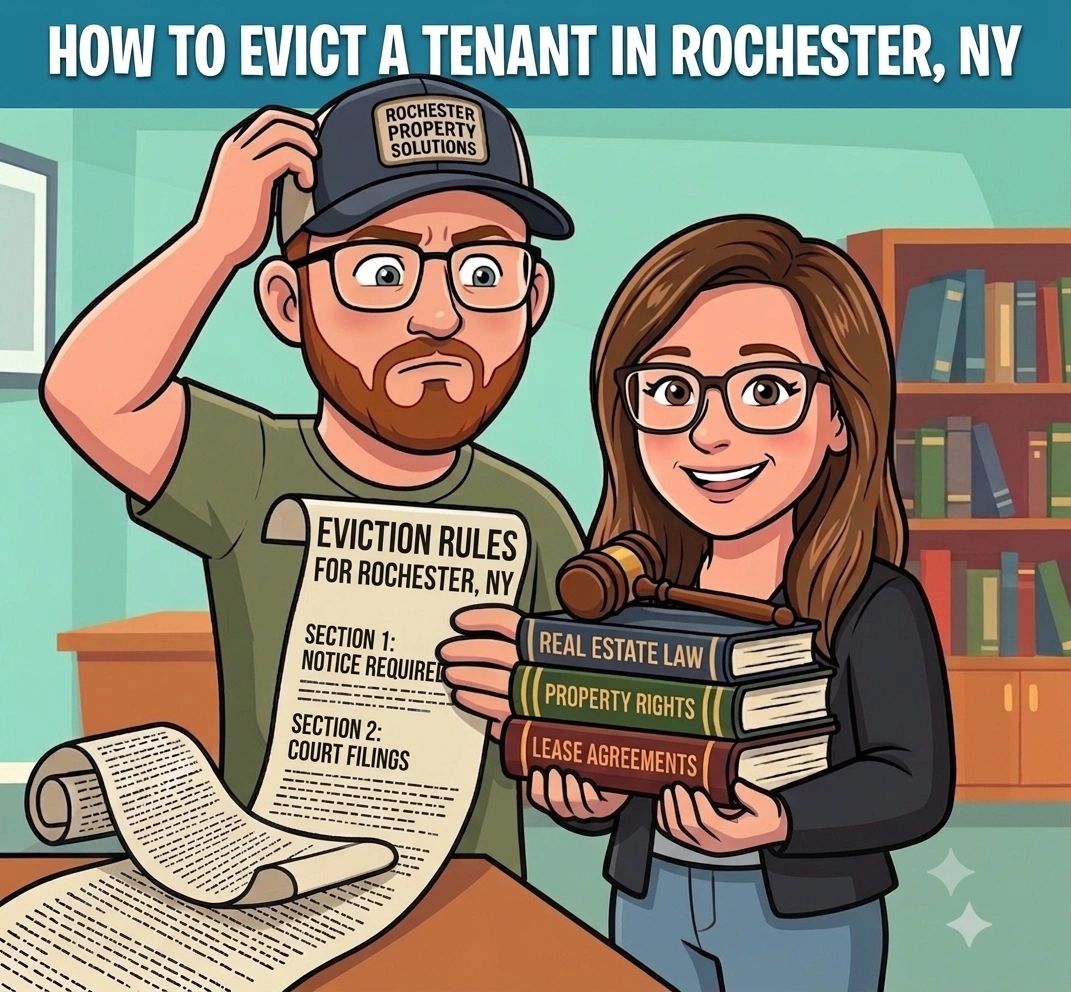
How to Evict a Tenant in New York: What Every Rochester Landlord Should Know
You own a duplex in Rochester. You live in Phoenix. At 9pm your phone lights up: the tenant in Unit B has not paid since August, they have stopped answering, and a neighbor just texted you a photo of a couch parked on the front lawn. From two thousand miles away, what can you actually do about it?
In New York, the honest answer is: not much on your own, and nothing fast.
Eviction here is strict, it is slow, and it is built to give the tenant every reasonable chance to stay. Miss one step and the judge will be telling you to head back to start, do not pass go, do not collect $200.
We run hundreds of units across Rochester and Monroe County. I am a property manager, I am not an attorney and I don’t even play one on TV. This is the practitioner's map, not legal advice, and I will flag the spots where you genuinely need an attorney (read: this is not a DIY sport).
The short version
You pick your grounds. You serve the exact right notice, the exact right way. You file in the exact right court. You win a judgment and/or warrant. Then you get on the marshall’s calendar (or the sheriff depending on where exactly you are), he carries out the warrant. You need to be prepared to lock that baby up tight immediately at this point. Fumble any one of those and you start over, on the tenant's timeline, not yours. And no matter how satisfying it sounds at 9pm from Phoenix, you never touch the locks (or the utility meters, or the doors) yourself.
Now the long version, because the details are where the money is.
Step 1: Pick your grounds, send the right notice
Eviction starts with a reason, and the reason picks the notice.
Nonpayment | Rent is not even late until at least the fifth of the month. After that you owe a written five-day reminder, sent by certified mail, then a 14-day demand to pay or move out. The old three-day demand is long gone. If the tenant pays in full inside those 14 days, the case is over before it starts, and honestly, that is a win. Rinse and repeat the next month if necessary.
Lease violation | You generally serve a notice to cure first, giving the tenant a real chance to fix the problem, and only then a notice of termination if they do not.
Holdover | The lease ended and the tenant stayed. You serve a termination notice on the 30, 60, or 90 day timeline tied to how long they have lived there. Get that timeline wrong and the whole thing unravels, which is why it has its own notice guide.
Inside the City of Rochester there is an extra layer. Under Good Cause Eviction, a covered tenant can fight a nonpayment case by arguing the rent increase behind it was unreasonable, and you generally need a recognized good-cause reason to refuse a renewal at all. In the Monroe County suburbs, which have not opted in, that layer does not apply yet.
Do Not generate any of these notices yourself. It might sound like a good idea to ask ChatGPT or Claude to conjure you up a pretty looking 14 day notice. I guarantee you, that is the fastest way to waste months of your time you will ever find. The last thing you want is to get into court and have your case thrown out on day one for a technicality.
Call your attorney. If you don’t have one, ask me and I’ll refer you to one. This write up is helpful in knowing what to expect while going through the process, it’s not going to turn you into a DIY housing court hero.
Step 2: File the petition in the right court
The notice period runs out, nothing is resolved, and now your attorney files a petition and a notice of petition with the court that covers the property. File the wrong notice or in the wrong court and you have just donated a few weeks of your time for nothing. This is why we contact an attorney on day one, am I sounding like a broken record yet?
Don’t want to pay for an attorney? 1 If you hold the property in an LLC or a corporation, it’s not up to you anyway. New York generally will not let the business walk into court and represent itself. In practice that means a licensed attorney has to file, so line one up before the clock is running, not the morning you planned to file. How it applies to your exact setup is a question for that attorney, not a blog. 2 It’s way more expensive not to hire one for a housing court case. The state's Guide to Non-payment eviction and Guide to hold over eviction walk through what to expect and are worth a skim before you start.
Step 3: Serve the court papers correctly
The petition and notice of petition have to be served the way the law demands, usually by personal delivery or by "nail and mail," which means posting the papers to the door and mailing copies. Not so fast my do-it-yourself friend, before you go grab your stamps: you generally cannot serve your own papers in New York. The state stipulates the person who serves the petition has to be someone who is not a party to the case, so an owner or your own employee handing them over can sink the whole thing before your voyage is even underway. Use a process server, and keep your proof of service, you will need that later. Bad service is one of the most common reasons a case gets tossed, and “I sent it” is not proof of anything. If you want it to be bulletproof, have your attorney draft the notice and serve it through their process server.
Step 4: Go to the hearing
Both sides show up. If the tenant does not, you may win by default. If they do, generally the resident is given free legal representation and then the judge hears it out. Win, and the court issues a judgment of possession, but you are far more likely to get an adjournment on this round for the resident to look into aid options.
This is where an element of strategy comes into play. Consult with your legal representative before the hearing to determine how you are going to proceed, are you willing to make any concessions in return for possession of the unit? Or do you want to hold a hard line at all costs? You have options here that could make a real difference in your outcome.
Temper your expectations here. In some cases a judge can grant a hardship stay for a good stretch of time, and in a holdover built on a lease violation, New York law generally gives the tenant a chance to fix the problem and stay, even after you win. How far a judge takes either one varies case by case, which is exactly the kind of thing your attorney reads better than a blog can. The theme holds: New York is not fast. Plan for it. Even better than that is to get your tenant placement process on lock so you don’t have to go through this in the first place, I’m not going to rub salt in the wound, but we can make a mental note of that for next time.
Step 5: The warrant
Once you have been granted a warrant of eviction, you hand it to the Marshall or the Sheriff depending on your location, they will post the 14-day eviction notice and then schedule the actual possession date with you. Be ready when that day comes: the deputies expect you to show up with enough hands to firmly secure the unit, and they will cancel and make you reschedule if you are not prepared.
Up until the date of possession there is still the chance for an order to show cause, this sends you back to court for an emergency hearing and delays your possession date further. I’m going to leave that there for now, we can do another post on just that topic another time.
What you do not do is any of it yourself. Not the locks, not posting the notice, not the belongings on the curb. Self-help eviction is treated harshly under New York law. It is a class A misdemeanor, and it can expose you to steep civil penalties and triple damages owed to the tenant. Changing the locks feels productive for about a day, right up until it flips you from the person owed rent into the person writing a very large check. Bad trade. Once you have possession of the unit, the resident has 30 days to retrieve their belongings from you (and you must facilitate this process) before you can discard the belongings.
So how long does this really take?
There is no clean number, and anyone who gives you one is guessing. A straightforward nonpayment case might wrap in a few months. A contested holdover with a hardship stay can stretch well past that. The honest truth is that once a tenant decides to dig in, the timeline is mostly out of your hands, get a good lawyer and hold on tight.
Which is exactly why the real work happens before any of this: screening, documentation, and clean paperwork. It also helps to know that many Rochester tenants have access to free representation through Legal Assistance of Western New York, so a sloppy file on your end will get found. Assume a sharp opponent and build accordingly.
The bottom line
The best eviction case is the one you prevented before it even starts by having thorough and extensive screening practices in place.
When you do find yourself needing to go through the eviction process despite your best efforts, know that the process rewards the owner who is patient and precise, and it punishes the one who is fast and frustrated. Right grounds, right notice, right court, right service, and never your own hands on the door. If you are not even sure which path you are on, start with our lease termination overview.
Frequently asked questions
How long does an eviction take in New York?
There is no fixed number. A clean nonpayment case can resolve in a couple of months, while a contested holdover, especially with a hardship stay, can run much longer. Once it’s clear that the path forward has to be through an eviction proceeding, the timeline is largely out of your hands. Screening, screening, screening.
How much does it cost to evict a tenant in NY?
Expect an initial service fee, court filing fee, a fee or two to the Marshall or Sheriff to serve and then execute the warrant, attorney fees (which may include some of the other fees listed depending on your attorney and how they bill), plus the cost to secure the unit on the day of possession. If the property is in an LLC, an attorney is generally required, so budget for that from the start.
Do I need a lawyer to evict a tenant in New York?
An individual owner can technically file alone, though I would not recommend this unless you are very into gambling or you like paying to waste your time. If you hold the property in an LLC or corporation, New York generally requires a licensed attorney to bring the case.
Can a landlord evict a tenant in the winter in New York?
Yes. New York has no seasonal or winter eviction ban. The eviction itself just has to be carried out on a business day during daylight hours.
What is the first step to evict a tenant who is not paying rent in Rochester?
A written five-day reminder by certified mail once rent is late, then a 14-day demand to pay or move out. Only after that can you file in court. Alternatively, you could contact your attorney and retain them to start the process on your behalf.
Rather not run this gauntlet from two thousand miles away? Thorp Property Management handles this soup to nuts alongside our legal team for owners across Monroe and surrounding Counties, so a problem tenant stays our problem, not your 9pm phone call. Your property earns more. You stress less.
Free Resources for Rochester Property Owners
Complete the form below:
✅ FREE Rochester NY Landlording Playbook
✅ FREE Scope of Work Template
✅ FREE Rental Analysis Calculator
✅ Property Management Services Overview
👉 CLICK HERE TO GET ACCESS TO THE ABOVE!